
From resistence to real presence:
TouchDIVER Pro force feedback
Haptic technologies aim to recreate the sense of touch by simulating physical interactions between users and virtual or remote objects. Traditional approaches to force feedback often rely on kinesthetic mechanisms, where forces are applied to oppose or guide finger movement. While effective, these methods typically simulate interaction indirectly, rather than reproducing the true sensation of contact at the skin level.
TouchDIVER represents a shift in this paradigm by focusing on cutaneous force feedback, delivering sensations directly to the fingertip. This approach enables a more realistic perception of touch, enhancing immersion and fidelity in human-machine interaction.

Limits of passive force feedback
Conventional haptic systems commonly generate force feedback by pulling the user’s fingers backward or resisting their motion. This creates the illusion of interacting with an object, such as encountering resistance when pressing against a virtual surface. However, this method primarily engages the user’s sense of movement and force through joints and muscles, rather than directly stimulating the skin. As a result, the sensation often lacks realism.
Moreover, these passive approaches only work if the user moves his fingers. Nevertheless, in most cases, the hand goes in contact with objects and surfaces with steady fingers (e.g. pressing a button, exploring a surface): in these cases passive force feedback mechanisms can’t provide any force feedback.
The TouchDIVER approach
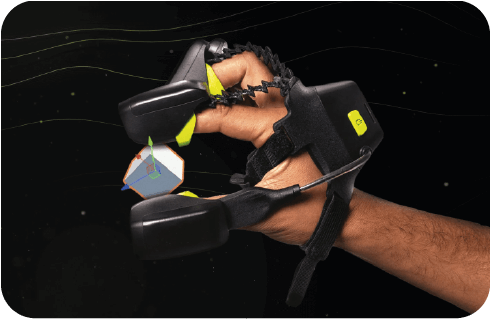
TouchDIVER overcomes these limitations by applying active cutaneous force directly to the fingertip. Its design is based on a mechanical transmission actuated by a servomotor, which drives an active plate to press against the skin. This allows the device to deliver controlled and highly precise tactile stimuli.
With a maximum force of 5 Newtons and a resolution of 0.02 Newtons, TouchDIVER can finely modulate the pressure applied to the fingertip. This precision enables users to perceive detailed variations in virtual objects, such as differences in stiffness or the presence of small surface features.
A key innovation of TouchDIVER is the co-localization of multiple feedback modalities, combining force, texture vibrations, and thermal cues on the same skin area. This integration creates a more unified and realistic tactile experience. As a result, users can perceive three-dimensional shapes and surface properties, such as bumps on a wavy texture, interpreting both geometry and material characteristics through touch alone.
Rethinking Force Feedback with TouchDIVER Pro
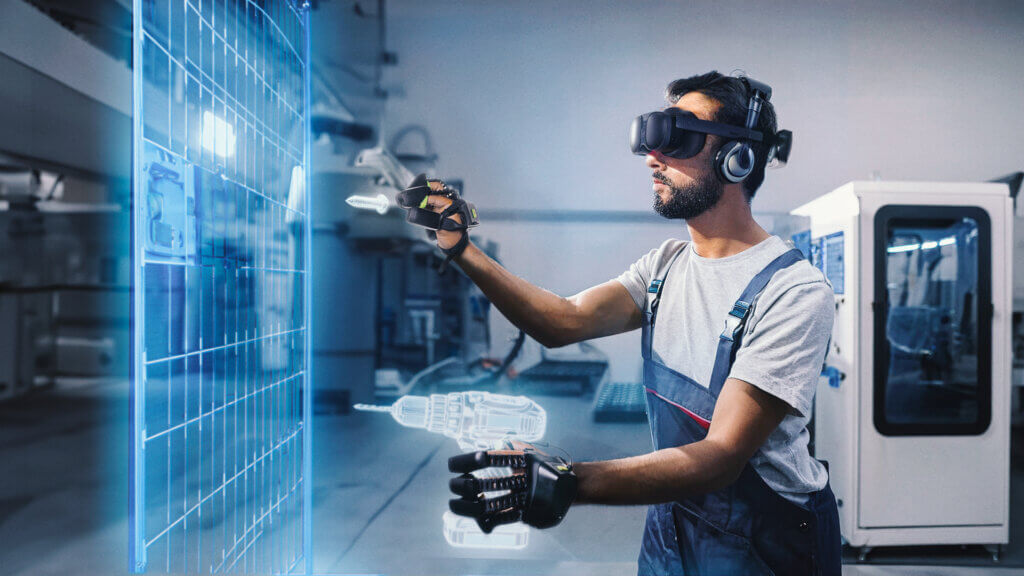
TouchDIVER introduces a novel approach to force feedback by shifting from indirect, motion-based simulation to direct, localized cutaneous interaction. By actively applying force to the fingertip and integrating multiple sensory cues in a single contact area, it enables a more realistic and immersive perception of virtual objects.
This advancement moves haptic technology closer to replicating the true experience of touch, where users do not simply sense resistance, but genuinely feel the presence, shape and physical properties of objects.